402 National Program & Printing Co.: Chicago, Illinois. Circa 1927.
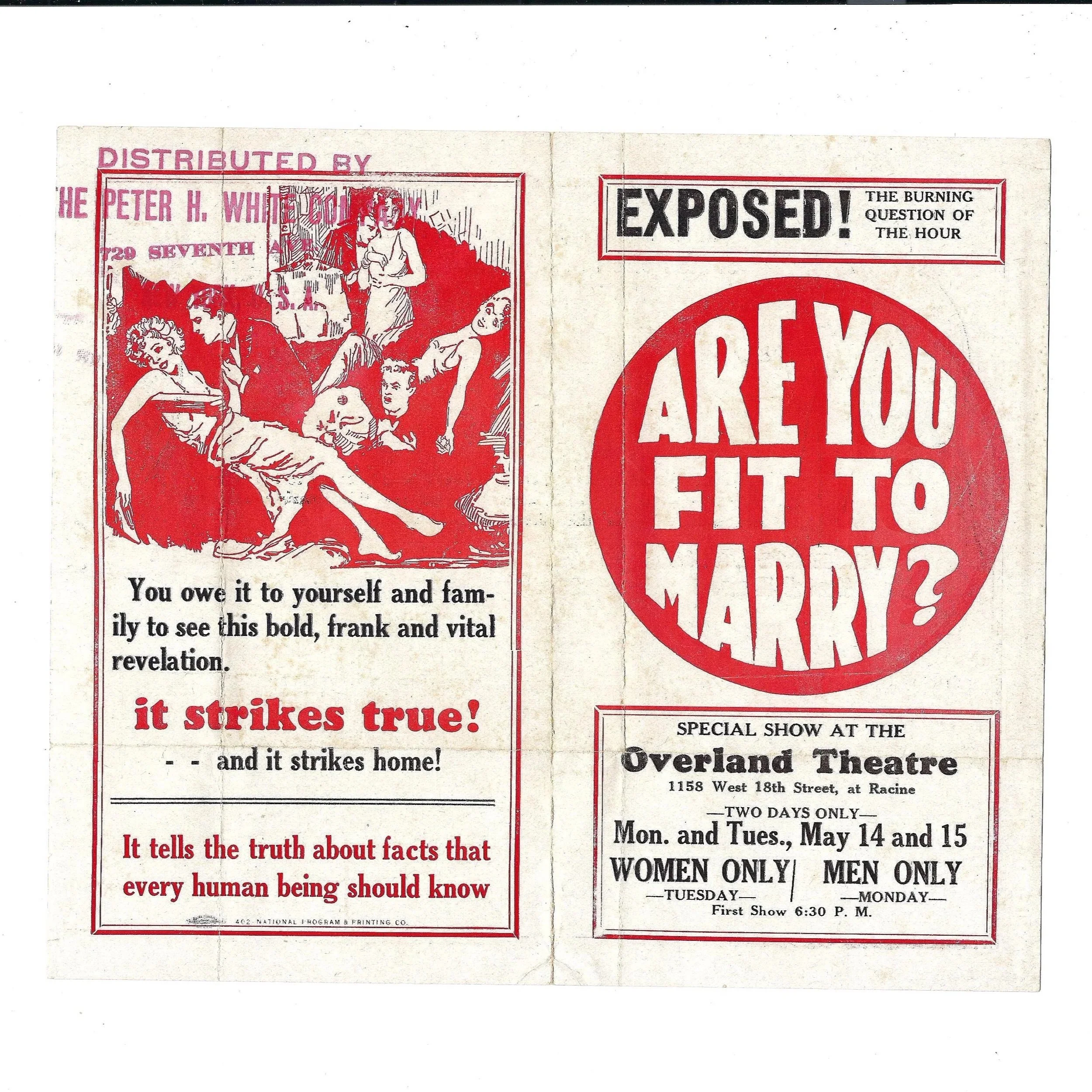
Handbill, 5” x 7.5”. Red inkstamp at verso reading, “Distributed by Peter H. White Company, 729 Seventh Ave,” at rear cover. CONDITION: Very good, old folds, some fading to text.
A scarce flier advertising a screening of a wildly popular eugenics film, here salaciously illustrated with images of jazz-age squalor and sin.
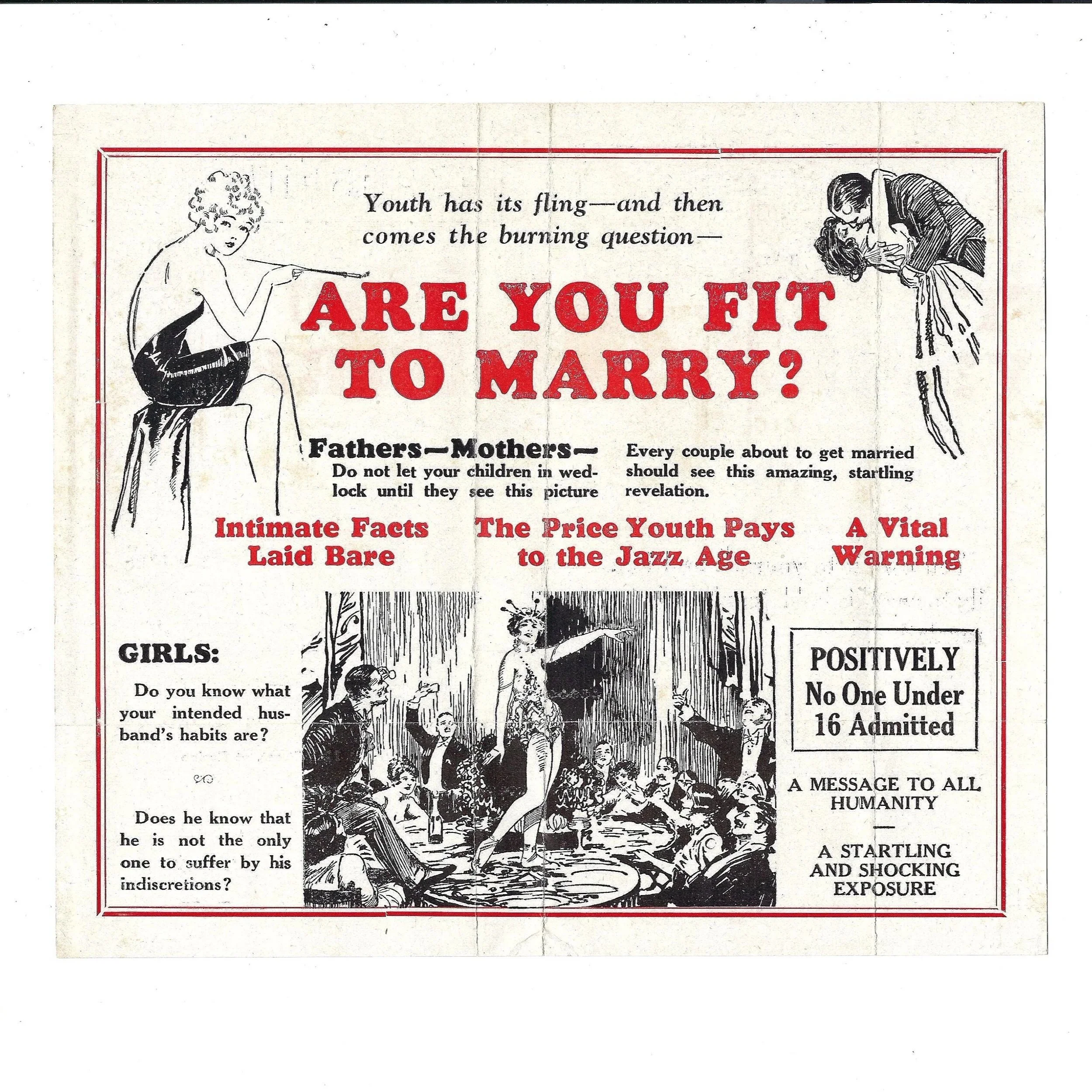
This handbill promotes a “special show” of “Are you Fit to Marry?,” the 1927 adaptation of a popular pre-war eugenics film, “The Black Stork” to be screened at the Overland Theatre, located in Chicago at 1158 West 18th Street on the corner of Racine avenue and May street. Absolutely “no one under 16” was admitted to the show. Hinting at the fear of “defective” children who were thought to be caused by engaging in “eugenic risks” such as fornicating out of wedlock, the handbill warns “Fathers–Mothers–do not let your children in wedlock until they see this picture,” because men especially do not know that they “are not the only ones to suffer by” their “indiscretions.”
The source-film for “Are You Fit to Marry?,” the “Black Stork,” was written and directed in 1916 by Jack Lait “and produced by William Randolph Hearst's International Film Service. In the framing story…a male physician whose daughter has just announced that she…plans to be married, pressures the…suitor to undergo a physical examination for eugenic fitness before…the father…will approve the marriage” (Bioethics at Georgetown). This plot was conceived after the Chicago-based Doctor Haiselden refused to perform life-saving surgery on the “baby Bollinger” in 1915. As Helen Keller recounts, Haiselden let this cognitively impaired and blind baby die to “spare them from a life of misery” because he believed that “a human life is sacred only when it may be of some use to itself and to the world.”
Sources Consulted: Keller, Helen. “Dr. Haiselden’s Service to Society Allowing the Bollinger Baby to Die, 1915,” at Helen Keller Archive online; “Are You Fit to Marry?” at Georgetown Bioethics Library online.
402 National Program & Printing Co.: Chicago, Illinois. Circa 1927.
Handbill, 5” x 7.5”. Red inkstamp at verso reading, “Distributed by Peter H. White Company, 729 Seventh Ave,” at rear cover. CONDITION: Very good, old folds, some fading to text.
A scarce flier advertising a screening of a wildly popular eugenics film, here salaciously illustrated with images of jazz-age squalor and sin.
This handbill promotes a “special show” of “Are you Fit to Marry?,” the 1927 adaptation of a popular pre-war eugenics film, “The Black Stork” to be screened at the Overland Theatre, located in Chicago at 1158 West 18th Street on the corner of Racine avenue and May street. Absolutely “no one under 16” was admitted to the show. Hinting at the fear of “defective” children who were thought to be caused by engaging in “eugenic risks” such as fornicating out of wedlock, the handbill warns “Fathers–Mothers–do not let your children in wedlock until they see this picture,” because men especially do not know that they “are not the only ones to suffer by” their “indiscretions.”
The source-film for “Are You Fit to Marry?,” the “Black Stork,” was written and directed in 1916 by Jack Lait “and produced by William Randolph Hearst's International Film Service. In the framing story…a male physician whose daughter has just announced that she…plans to be married, pressures the…suitor to undergo a physical examination for eugenic fitness before…the father…will approve the marriage” (Bioethics at Georgetown). This plot was conceived after the Chicago-based Doctor Haiselden refused to perform life-saving surgery on the “baby Bollinger” in 1915. As Helen Keller recounts, Haiselden let this cognitively impaired and blind baby die to “spare them from a life of misery” because he believed that “a human life is sacred only when it may be of some use to itself and to the world.”
Sources Consulted: Keller, Helen. “Dr. Haiselden’s Service to Society Allowing the Bollinger Baby to Die, 1915,” at Helen Keller Archive online; “Are You Fit to Marry?” at Georgetown Bioethics Library online.